Note: This article contains affiliate links. If you click on these links and make a purchase, I may earn a small commission at no extra cost to you. This helps support my research and content. Read my full affiliate disclosure here.
When you rely on a Volkswagen Jetta every day, the right brake fluid matters for consistent stopping power and long-term system health. Old or unsuitable fluid can reduce pedal feel, raise the risk of vapor lock, and accelerate corrosion in brake components. This guide highlights the top shortlisted brake fluids for Volkswagen Jetta owners and explains the criteria used to evaluate them, including boiling point and chemical compatibility. Below you will find the best picks for common driving needs and service intervals, followed by practical buying considerations.
Looking for other parts? See all Volkswagen Jetta parts & accessories.
Top Picks at a Glance
| Best Reviewed A top-rated pick with lots of positive feedback | Motul RBF 600 Racing Brake Fluid, 500 ml |  |
| Most Popular A crowd favorite that many people choose with confidence | ITEQ Brake Fluid Tester Pen (calibrated for DOT3/DOT4) |  |
| Best Quality Built to a higher standard if you want something more solid | Johnsen's Premium Synthetic DOT-4 Brake Fluid, 1 Gallon |  |
| Best Budget The cheapest option that still gets the job done reliably | Liqui Moly Brake Fluid DOT 5.1, 250 ml |  |
| Most Sold A high-volume bestseller chosen again and again | Valvoline DOT 3 & DOT 4 Synthetic Brake Fluid, 32 oz |  |
| Best Value for Money The sweet spot between price and what you get | Motul DOT 5.1 Synthetic Brake Fluid (500 ml, 2-pack) |  |
| Best Overall The best all-around choice for most situations | Bosch ESI6 Low Viscosity Extended Life Brake Fluid, 1 Quart |  |
1. Motul RBF 600 Racing Brake Fluid, 500 ml

| Liquid Volume | 500 Milliliters |
|---|---|
| Fluid Type | 100% synthetic DOT 4 |
| Wet Boiling Point | 216°C / 420°F |
| Dry Boiling Point | 312°C / 593°F |
Motul RBF 600 is a fully synthetic DOT 4 brake fluid designed to keep hydraulic brake and clutch systems performing under high thermal stress. It is typically used when brakes see repeated hard use such as track days, spirited driving, or towing, and is sold in a 500 ml bottle intended for system fills or partial flushes. The standout feature is its very high dry boiling point (reported at 312 C / 593 F) and strong wet boiling performance, which reduces the risk of vapor lock and brake fade during prolonged heavy braking. Because it is non-silicone and highly hygroscopic, it requires more frequent changes than some fluids if the vehicle is exposed to moist environments or used as a daily driver. The liquid’s racing focus delivers consistent pedal feel and thermal stability, but owners should plan routine flush intervals and follow proper bleeding procedures to get the promised performance. For Volkswagen Jetta use, it offers robust protection during occasional track sessions or aggressive driving while still functioning in everyday street braking systems when maintained correctly.
Best for: Reliability-focused buyers who prioritize brake-system stability under high heat and want a fluid that minimizes fade during aggressive driving or occasional track use while accepting a maintenance schedule.
Less Ideal for: Drivers who never push their Jetta beyond light street use or who do not want the added maintenance of regular fluid changes should consider lower-maintenance DOT 4 options.
- Very high dry boiling point for sustained heavy braking.
- Strong wet boiling resistance to reduce vapor lock in wet conditions.
- 100% synthetic formula for thermal stability and consistent pedal feel.
- Non-silicone formula compatible with typical vehicle brake systems meeting DOT 4 standards.
- Highly hygroscopic so it absorbs moisture and needs more frequent replacement in humid or daily-use conditions.
- Sold in a single 500 ml bottle which may require buying multiple bottles for a full system flush.
Verdict Motul RBF 600 is a race-oriented DOT 4 fluid that delivers exceptional thermal resistance for a Volkswagen Jetta used for aggressive driving, but it demands regular changes because it soaks up moisture.
2. ITEQ Brake Fluid Tester Pen (calibrated for DOT3/DOT4)

| Calibrated for | DOT3, DOT4 |
|---|---|
| Power | 1 AAA battery |
| Indicators | 5 LED moisture levels |
| Auto power-off | 12 seconds |
The ITEQ brake fluid tester is a simple, handheld conductance tester that tells you how much water is in DOT3 or DOT4 brake fluid by illuminating up to five LEDs. You turn it on, dip the probe into the master cylinder reservoir, and the lights show a rough percentage range of moisture so you can decide if fluid needs attention. It is convenient for quick checks during routine maintenance and can prevent unnecessary brake-system work by confirming fluid condition before committing to a full fluid change. The tester runs on a single AAA battery, powers off automatically, and includes a protective cap for the probe. Limitations are that it measures conductivity at the reservoir only and does not replace lab-grade boiling-point testers or fluid analysis; readings can be affected by probe contamination or inconsistent immersion technique. A few users report battery cover or button durability issues, so handle the unit carefully and rinse the probe between tests to avoid cross-contamination.
Best for: Drivers who value convenience and quick preventative checks to avoid unnecessary brake jobs on a Volkswagen Jetta and prefer a simple, at-a-glance tool during routine inspections.
Less Ideal for: Professional shops or technicians who need laboratory-accurate boiling point data or repeatable, shop-grade measurements for warranty work should choose higher-end testing equipment instead.
- Fast, one-step test delivers a moisture range in seconds without tools or sampling
- Calibrated specifically for DOT3 and DOT4, covering the brake fluids used in many Volkswagen Jetta models
- Auto shutoff and battery check LED help conserve power and confirm readiness
- Small, pocketable design with a protective cap makes it easy to store in a Jetta owner’s toolkit
- Reads reservoir fluid only so it may miss contaminated fluid deeper in the braking circuit
- Conductance method gives a percentage range rather than an exact lab measurement
- Some users report intermittent button or battery-cover durability problems
Verdict A cheap, convenient way to spot high water levels in a Jetta’s brake reservoir, but not a substitute for shop-grade testing when precision is required.
3. Johnsen's Premium Synthetic DOT-4 Brake Fluid, 1 Gallon

| Liquid Volume | 128 Fluid Ounces |
|---|---|
| Upper Temperature Rating | 446 Degrees Fahrenheit |
| Viscosity | Stable over wide temperature range, compatible with DOT 3 and DOT 4 standards |
| Recommended Uses For Product | Brake oil |
| Specific Uses For Product | Automotive brake systems |
Johnsen's Premium Synthetic DOT-4 is a one-gallon brake fluid aimed at high-heat performance and full-system service. It is formulated to meet DOT-4 specifications while maintaining compatibility with DOT-3 systems, so it can be used for a complete flush or for topping off in vehicles that call for DOT-4. The fluid advertises a high boiling resistance and additives to reduce vapor lock and moisture absorption, which helps preserve firm pedal feel and resist fade during spirited driving. The large gallon jug suits shop use or owners who perform regular full flushes. Limitations to note are that DOT-4 performance depends on a full flush to realize the higher boiling point versus mixing with older DOT-3 fluid, and bulk jugs require careful handling and a proper funnel to avoid spills and contamination. For a Volkswagen Jetta this product provides factory-quality braking performance when DOT-4 is specified and when you want a fluid that stands up to higher operating temperatures.
Best for: Performance-oriented Volkswagen Jetta owners who prioritize braking consistency and resistance to fade during spirited driving and want a shop-sized supply for regular full-system maintenance.
Less Ideal for: Drivers who prefer pre-measured small bottles for occasional top-offs or those who need a silicone-based DOT-5 fluid should look elsewhere.
- Meets DOT-4 standards and is compatible with DOT-3 systems for easy topping off
- Formulated to resist vapor lock and reduce moisture absorption for more consistent pedal feel
- Large 1-gallon size is economical for full-system flushes or frequent servicing
- Designed for use in disc, drum, and ABS brake systems so it fits typical Jetta braking setups
- Contains higher-performance additives but requires a full flush to achieve the full DOT-4 boiling point advantage
- Sold in a bulk jug that can be awkward to pour without a funnel or transfer tool
Verdict A robust, shop-friendly DOT-4 brake fluid that delivers higher-heat resistance for Jetta owners who service their brakes and demand fade-resistant performance.
4. Liqui Moly Brake Fluid DOT 5.1, 250 ml
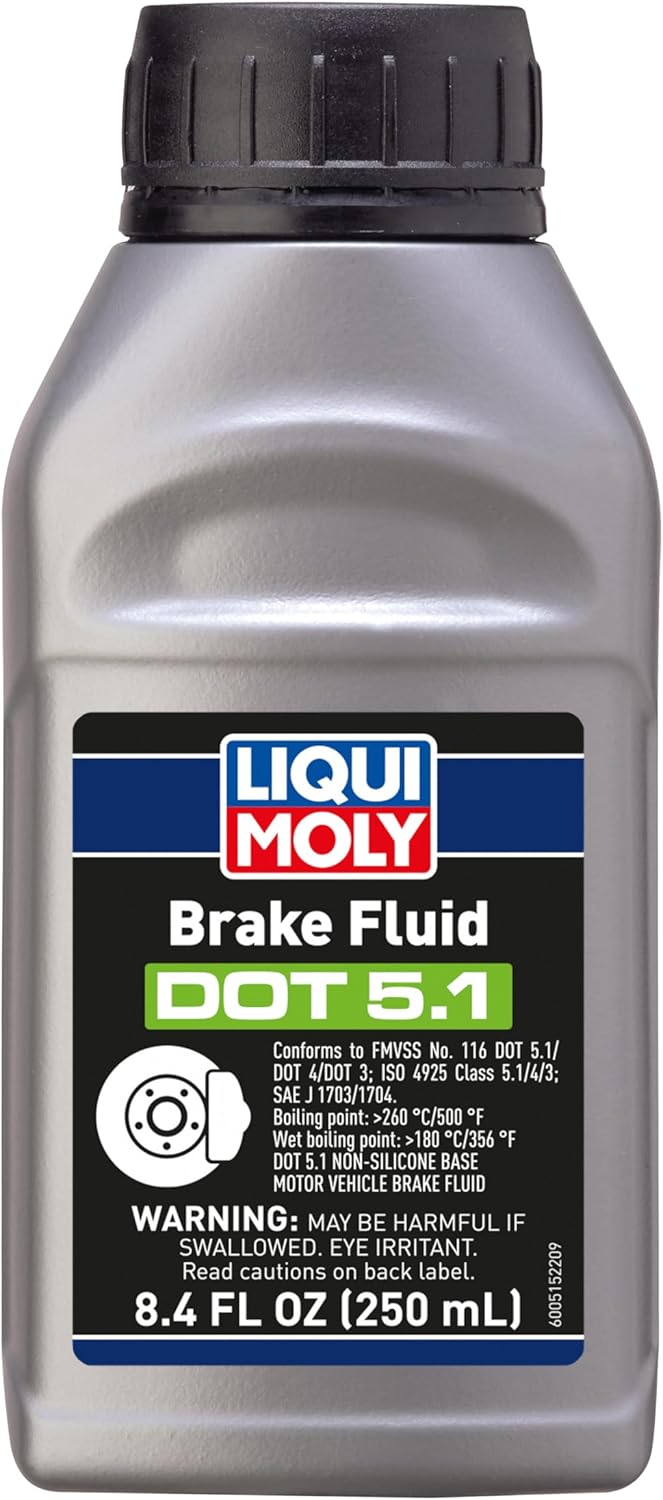
| Liquid Volume | 250 Milliliters |
|---|---|
| Brand | Liqui Moly |
| Recommended Uses For Product | Automotive |
| Item Form | Liquid |
Liqui Moly DOT 5.1 is a synthetic brake fluid aimed at maintaining stable braking performance under high temperatures and moisture exposure. It is typically used for topping off or flushing hydraulic brake systems where a DOT 5.1 specification is required. The formulation offers higher wet and dry boiling points than DOT 3 and DOT 4 fluids and includes inhibitors to help limit corrosion and oxidation in the brake circuit. In practical use the 250 ml size is convenient for a single bleed or a top-up and the narrow bottle helps with controlled pouring. The product is miscible with other high-quality synthetic brake fluids, so it can be added during service, but DOT 5.1 is not compatible with silicone-based DOT 5 fluids. Buyers should be aware this is a small bottle intended for service tasks rather than complete system refills and the fluid requires careful handling and protective equipment due to health hazards listed on the label.
Best for: Practical budget-conscious owners who prioritize getting a reliable, high-temperature DOT 5.1 fluid for occasional service tasks on their Volkswagen Jetta without overspending.
Less Ideal for: Buyers who need a full-system refill, routine heavy-duty track use, or require a silicone-based DOT 5 fluid should look at larger volumes or different fluid types.
- Synthetic DOT 5.1 formula with higher wet and dry boiling points than DOT 3/4
- Includes corrosion and oxidation inhibitors for longer system protection
- 250 ml bottle size is convenient for topping off or a single bleed procedure
- Compatible and miscible with other high-quality synthetic brake fluids
- Small 250 ml bottle is not suitable for full system refills
- Not compatible with silicone-based DOT 5 brake fluids
- Contains chemicals that require protective handling due to health warnings
Verdict A cost-conscious way to get DOT 5.1 braking performance for occasional Jetta service tasks, but buy larger quantities for full-system jobs.
5. Valvoline DOT 3 & DOT 4 Synthetic Brake Fluid, 32 oz

| Unit Count | 32.0 Fluid Ounces |
|---|---|
| Material | Abs |
| Recommended Uses For Product | Automotive |
| Specific Uses For Product | Vehicle Brake Systems |
Valvoline DOT 3 & DOT 4 Synthetic Brake Fluid is a glycol-based hydraulic fluid intended for flushing and refilling vehicle brake systems. It meets both DOT 3 and DOT 4 specifications so it can be used where the Volkswagen Jetta service manual allows either grade, and it mixes with conventional fluids for straightforward top-ups or complete system flushes. The formula emphasizes a high boiling point and low moisture uptake to resist vapor lock and reduce brake fade under heavier braking, which helps maintain firm pedal feel during repeated stops. Users report clean bleeding with minimal foaming, making it easier to purge air from ABS circuitry and calipers. The product comes in a 32 oz bottle sized for a single full-service plus some leftover for follow-up maintenance. Limitations are typical of glycol fluids: it is hygroscopic so it will absorb moisture over time and requires periodic replacement per factory service intervals, and it is not suitable where a manufacturer specifically calls for a DOT 5 silicone fluid.
Best for: A cautious Volkswagen Jetta owner who prioritizes reliable, factory-compatible maintenance and wants a versatile brake fluid that fits standard service procedures.
Less Ideal for: Drivers seeking a non-hygroscopic silicone brake fluid or those requiring specialist racing-grade fluids with extreme dry boiling points.
- Meets both DOT 3 and DOT 4 specifications for flexible use where Jetta allows either grade
- High boiling point and low-moisture formula improve resistance to vapor lock and brake fade
- Mixes with conventional glycol brake fluids so it can be used for top-ups and full flushes
- Clean bleeding with minimal foaming simplifies purging air from ABS modules and calipers
- Hygroscopic nature means it must be replaced on the manufacturer recommended schedule
- Not suitable for systems that require DOT 5 silicone fluid
Verdict A dependable, factory-compatible DOT 3/4 brake fluid for Volkswagen Jetta maintenance that balances thermal protection and ease of use but requires routine replacement due to moisture absorption.
6. Motul DOT 5.1 Synthetic Brake Fluid (500 ml, 2-pack)

| Liquid Volume | 500 Milliliters |
|---|---|
| Viscosity | 820 centipoise at -40 degrees Celsius |
| Upper Temperature Rating | 516 Degrees Fahrenheit |
| Material | Synthetic |
Motul DOT 5.1 is a fully synthetic brake fluid intended for hydraulic brake and clutch systems that require DOT 5.1, DOT 4 or DOT 3 compatibility. It delivers a high dry boiling point and a wet boiling point rated well above DOT 4, which helps resist vapor lock under heavy use and retains braking performance after moisture absorption. The fluid’s relatively low cold-temperature viscosity improves flow through ABS micro-valves for quicker response during hard stops. It is mixable with glycol-based DOT 3/4/5.1 fluids but must never be blended with silicone or mineral-based fluids. In practice this product is useful for flushing and refilling a Volkswagen Jetta’s brake system when the vehicle’s maintenance schedule or service manual allows DOT 5.1 or compatible glycol-based fluids. Important limitations are that glycol fluids absorb moisture over time so regular replacement per manufacturer guidance is required, and this fluid’s aggressive chemistry means spilled fluid can damage paint and should be handled carefully. Follow Jetta-specific fluid specs before use.
Best for: Practical optimizers who prioritize getting reliable, higher-temperature braking performance for their Volkswagen Jetta without overspending, and who perform or supervise regular maintenance.
Less Ideal for: Owners who must follow a strict OEM-only fluid spec that forbids DOT 5.1 or those unwilling to observe recommended drain intervals and safe handling procedures should choose an alternative.
- High wet boiling point for better resistance to vapor lock under heavy or spirited driving.
- Low-temperature viscosity designed for reliable circulation in ABS valves and faster pedal response.
- 100% synthetic formulation compatible with DOT 3, DOT 4 and DOT 5.1 glycol-based systems.
- Sold as a two-bottle pack so you have enough fluid for a full system flush and clutch circuits on many vehicles.
- Not compatible with silicone-based DOT 5 or mineral-based fluids so careful verification is needed before mixing.
- Glycol-based fluids absorb moisture and require periodic replacement to maintain performance.
Verdict A cost-effective, high-boiling synthetic DOT 5.1 fluid that improves braking durability and ABS responsiveness for Jetta owners who need better heat resistance than standard DOT 4.
7. Bosch ESI6 Low Viscosity Extended Life Brake Fluid, 1 Quart

| Unit Count | 32 Fluid Ounces |
|---|---|
| Viscosity | 5w |
| Item Form | Liquid |
Bosch ESI6 is a next-generation brake fluid that combines a relatively low viscosity with a high wet boiling point to improve response from modern ABS and ESP-equipped systems. It is used as a full-system replacement or top-off in vehicles that call for DOT 3, DOT 4, or DOT 5.1 fluids and is designed to extend service intervals compared with conventional fluids. Practical benefits include improved lubricity to reduce wear and noise in hydraulic components, a high wet boiling point to resist vapor lock under heavy use, and backward compatibility with most poly-glycol brake systems introduced since 1990. For a Volkswagen Jetta, ESI6 can help preserve pedal feel and ESP responsiveness, especially in models that specify DOT 4 or DOT 5.1 behavior. Important limitations: it is not compatible with silicone-based DOT 5 systems, and optimum results require a full fluid change and proper bleeding rather than just topping off. Multiple quarts will be needed to flush a complete system.
Best for: Practical, balanced buyers who want a single fluid that improves responsiveness and longevity in a daily-driven Volkswagen Jetta without chasing race-grade products.
Less Ideal for: Owners who specifically require DOT 5 silicone fluid or who prefer specialized racing formulations tailored for track use should choose a different product.
- Low viscosity improves ESP and ABS response in modern braking systems
- High wet boiling point (~365°F) reduces risk of vapor formation under heavy use
- Extended service life compared with standard DOT 3 and DOT 4 fluids
- Compatible with DOT 3, DOT 4, and DOT 5.1 systems for top-off or replacement
- Not compatible with silicone-based DOT 5 systems
- Optimal performance requires a full fluid change and proper bleeding rather than just topping off
Verdict A versatile, longer-lasting low-viscosity brake fluid that suits a Volkswagen Jetta needing DOT 3/4/5.1 compatibility and improved ABS/ESP response, but not for DOT 5 silicone systems.
Choosing the Right Volkswagen Jetta Brake Fluid: Key Factors to Consider
Boiling Point (Dry and Wet)
Boiling point directly affects braking performance under heat. Dry boiling point reflects new-fluid thermal limits, while wet boiling point indicates performance after moisture absorption during service life. Higher wet boiling points reduce the chance of vapor formation that causes a spongy pedal under repeated or heavy braking. Choose a fluid whose wet boiling point meets the expected operating conditions and service interval of your driving. Remember that hygroscopic fluids absorb moisture over time, so initial dry boiling numbers are less relevant if the fluid will not be changed on a timely schedule.
DOT Rating and Specification
DOT classifications define baseline performance and composition differences that affect compatibility. Common ratings outline minimum boiling points and other safety attributes. Matching the DOT rating recommended by your vehicle manufacturer helps ensure chemical and seal compatibility with the brake system. Using a higher DOT-rated fluid can offer better thermal resistance but may have different chemical properties. Always check the vehicle’s service information to confirm acceptable DOT options for the Jetta before switching.
Chemical Compatibility With Seals and Components
Brake fluids interact directly with rubber hoses, caliper seals, master cylinder internals, and ABS components. Some formulations can cause swelling, hardening, or accelerated wear in incompatible materials. Compatibility reduces the risk of leaks and premature component failure. When selecting a fluid, look for documentation of material compatibility or OEM endorsements. If compatibility information is unclear, plan for closer inspection of hoses and seals at the next service to confirm there are no adverse effects.
Hygroscopic Properties and Service Interval
Most common brake fluids are hygroscopic and absorb moisture from the air, which lowers boiling points and can increase corrosion risk. How quickly a fluid absorbs moisture affects how often it should be replaced. Fluids with slower moisture uptake can extend safe service intervals, while slower-absorbing or specially formulated fluids may be preferred for infrequent maintenance schedules. Consider your driving environment and maintenance habits when choosing a fluid. If you drive in humid climates or cannot change fluid frequently, prioritize formulations with better resistance to moisture-related degradation.
Performance Needs and Driving Style
Your driving style determines how much thermal stress the brake fluid will see. Daily commuting with moderate braking places different demands than spirited driving or towing. Higher-performance formulations offer increased boiling points and more consistent pedal feel under severe use. Select a fluid that aligns with the most demanding scenarios you expect to encounter. For occasional high-stress use, pick a fluid with higher thermal margins and plan more frequent inspections or changes.
Compatibility With Brake-System Electronics
Modern Jetta models may include ABS, stability control, and other electronic brake control systems. Fluid formulation and cleanliness can affect sensor operation and valve function within control modules. Fluids that meet recommended specifications minimize the risk of contamination-related faults or erratic ABS responses. Keep the system sealed and use proper bleeding procedures to prevent air and contaminants from entering. When in doubt, follow the service manual for recommended fluid types and bleeding sequences to maintain reliable electronic brake performance.
FAQ
How often should I change Volkswagen Jetta brake fluid?
Service intervals vary by driving conditions and fluid type, but many technicians recommend checking fluid condition annually and changing every one to two years for hygroscopic fluids. If you drive in a humid climate or notice a spongy pedal, change the fluid sooner. Follow the vehicle’s maintenance schedule for the manufacturer’s recommended interval.
Can I mix different DOT-rated brake fluids in my Jetta?
Mixing fluids with different DOT ratings is generally not advised because formulations differ in chemistry and boiling characteristics. Some higher-rated fluids are chemically incompatible with lower-rated types. If you must top up, use the same DOT rating already in the system and plan a full flush and replacement as soon as practical.
What is the difference between DOT 3 and DOT 4 for a Jetta?
DOT 4 typically has higher boiling points and may contain additives to improve moisture tolerance compared with DOT 3. That can translate to better performance under heavier braking. However, compatibility with seals and what the vehicle manufacturer specifies should guide your choice. Check the service documentation for acceptable DOT ratings.
Is synthetic brake fluid necessary for everyday driving?
Synthetic or specially formulated fluids can offer higher boiling points and improved longevity, which benefit drivers who expose their brakes to higher thermal loads. For routine commuting with normal braking, a standard DOT-rated fluid that meets the manufacturer’s spec is usually sufficient. Consider synthetic options if you want greater thermal margin or longer service intervals.
Will a brake fluid flush improve braking performance?
A proper brake fluid flush removes moisture and contaminants that lower boiling points and can cause corrosion. Flushing with fresh fluid can restore pedal feel and maintain thermal capacity, particularly if the existing fluid is old or contaminated. It is one part of routine brake maintenance that supports consistent stopping performance.
How We Chose the Best Volkswagen Jetta Brake Fluid
To compile this list we applied vehicle-specific and fluid-technology filters relevant to Volkswagen Jetta owners. We prioritized fluids with documented wet and dry boiling points that meet or exceed the thermal demands of everyday and spirited driving. Chemical compatibility with the Jetta brake system materials and seals was assessed to avoid swelling or deterioration. We also considered fluid formulation stability under moisture absorption, as hygroscopic behavior affects service life. Additional criteria included manufacturer specifications and adherence to common DOT ratings, OEM cross-reference compatibility, and suitability for both routine maintenance and performance-oriented use. We excluded fluids that lacked verifiable technical data, did not meet standard safety certifications, or were intended only for specialty racing applications without recommended service intervals. The result is a focused set of options that balance thermal performance, material compatibility, and predictable maintenance schedules.
Our full evaluation process is outlined in our review methodology.
Conclusion
Choosing the right Volkswagen Jetta brake fluid comes down to matching DOT rating and chemical compatibility with the vehicle’s seals and brake electronics, while balancing boiling point needs for your driving style. Prioritize fluids with verified wet boiling points and clear compatibility data if you expect heavy braking or infrequent service. Remember that hygroscopic fluids require periodic replacement to maintain performance. If you are unsure which option fits your use case, focus on the vehicle manufacturer’s specifications and choose a fluid that offers the thermal margin and material compatibility you need.
Explore More:
- Check out all Volkswagen Jetta parts & accessories
- Explore Fluids & Chemicals
- Browse all Accessories